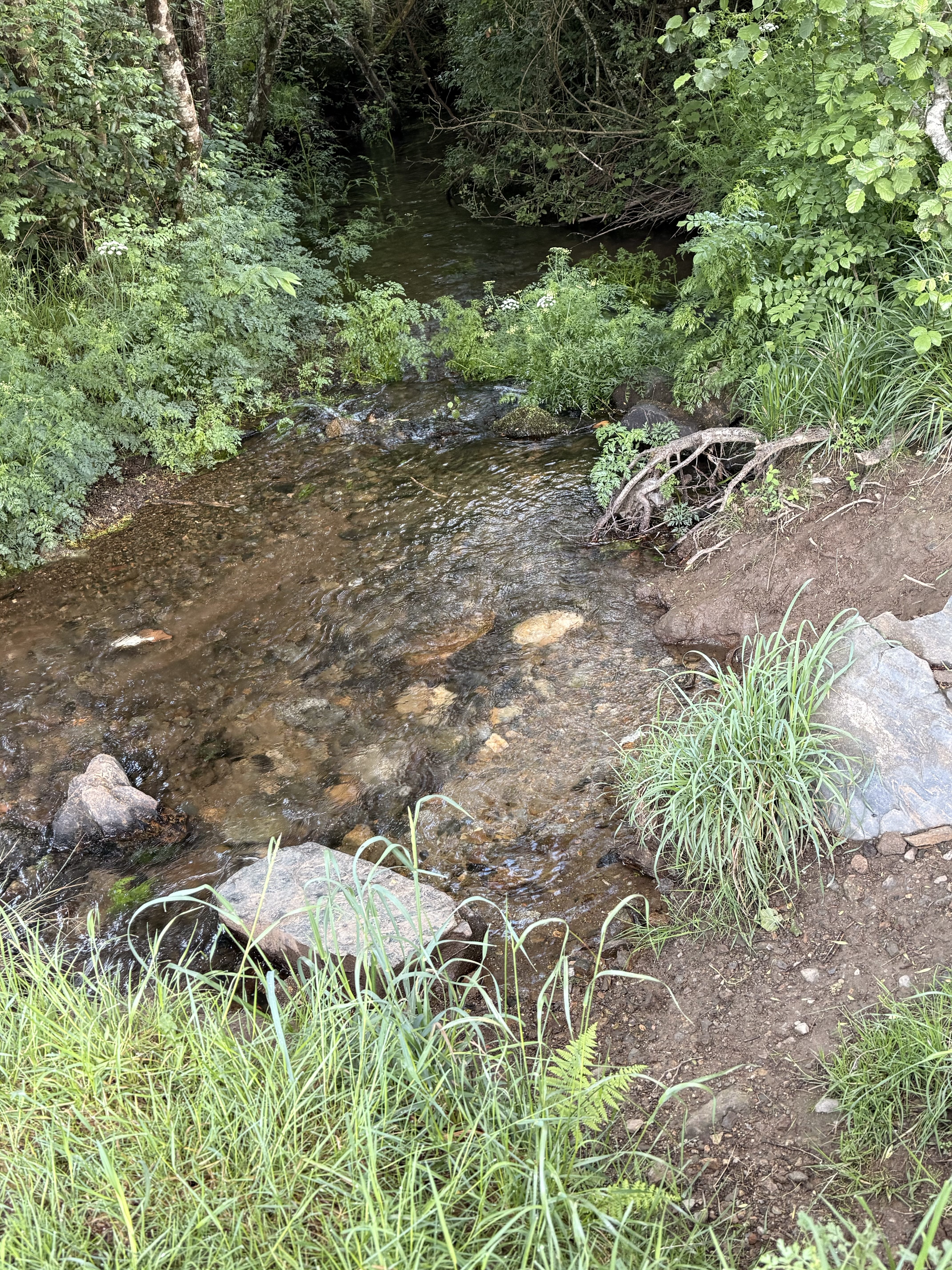
Lavacolla does not announce itself with towers, walls, or the grand remains of some medieval stronghold. It is a modest Galician village, quiet and easily passed through. Yet for the medieval pilgrim, this was one of the great thresholds of the Camino—the place where the long road began to give way to arrival.
Santiago lay only a few miles ahead.

By the time pilgrims reached Lavacolla, they had carried the dust of the road across mountains, through rain, and along muddy paths worn by generations before them. Their clothes would have been soiled, their bodies weary, and their feet marked by every mile. Here, in the waters of the Río Sionlla—often called the Lavacolla River—they stopped to wash themselves and their clothing before making the final approach to the Cathedral. Today in the 21st century, the river is a little hard to find. So we went searching for it and found a well-used crossing, There was no sign, and to trekkers they just high-tailed to Santiago de Compostela.

The Codex Calixtinus, the twelfth-century account of the pilgrimage, mentions this washing. It was certainly practical. Medieval pilgrims did not arrive with hot showers, fresh laundry, and a suitcase waiting at the next hotel. But the washing at Lavacolla meant more than getting the dirt off.
Water has always carried a language of its own. It recalled baptism: the washing away of the old life before entering something new. It also echoed the ritual bathing of pilgrims in the River Jordan after their journey to Jerusalem. The pilgrim entered the stream bearing the grime of the road and emerged prepared—at least outwardly—for the holy city. Clean clothes were put on. Hearts and minds were gathered. Santiago was near.

Even the name Lavacolla may preserve the memory of that washing. One explanation connects it with lavar, “to wash,” and cuello, “neck”—a place for washing the neck. The exact origin of the name is uncertain, but the association has endured because it belongs so naturally to what happened here.

The countryside around Lavacolla still bears the plain architecture of rural Galicia. Hórreos—raised granaries of stone and wood—stand on pillars above the damp ground. Flat stones beneath them kept mice and other pests from reaching the grain. These were not ornamental buildings. They protected the food that carried families through winter. Their beauty came from usefulness, patience, and the accumulated wisdom of people who understood both rain and hunger.

Beyond Lavacolla, the road continued toward San Lázaro, once the outermost neighborhood of Santiago. A hospital for pilgrims stood there as early as the twelfth century. It was also the boundary beyond which pilgrims suffering from leprosy could not pass. They had come almost to the end of the earth, almost within sight of the Cathedral, and yet could come no closer. The Iglesia de San Lázaro still marks that sorrowful boundary.
Lavacolla, then, was never important because of imposing buildings. Its importance lay in anticipation. Here the pilgrim paused between the journey and its fulfillment. The body was washed. Clean clothing replaced the garments of the road. Grain waited safely in the hórreos. The spires of Santiago were near, though perhaps not yet visible.
There are places along the Camino where history rises in stone. Lavacolla offers something quieter: a river, a washing, and a few final miles in which to prepare the heart for arrival.

Thanks for leaving a reply