Origins
Legend states St. James’s remains were transported to Spain, (where he labored for the Lord) after his martyrdom in Jerusalem (44AD), then was forgotten.
The Camino de Santiago began in the early 9th century (around 814–830 AD) following the miraculous discovery of the remains of Saint James the Greater in Galicia, Spain. After a hermit saw mysterious lights, Bishop Teodomiro identified a tomb in what is now Santiago de Compostela, prompting King Alfonso II to build a church, initiating pilgrimages from across Europe.
Below is the kind of infrastructure that was deliberately built (or upgraded) along what we now call the Camino Francés in the 10th–12th centuries.
By the 11th–12th centuries, the Camino Francés became the “golden age” route: rulers and church institutions leaned into it as a spiritual artery and as a way to populate and stabilize frontier territories—so you get bridges, hospitals, monasteries, and chartered towns appearing in a coordinated way.
Pilgrimage was not sustained merely by piety or preaching, but by enormous practical labor. Roads had to be cleared, marshes drained, rivers bridged, hospitals maintained, food distributed, and corpses buried. In medieval memory, certain figures became almost legendary because they turned dangerous wilderness into passable pilgrimage routes. The most famous of these was Santo Domingo de la Calzada:

The saying traditionally attached to him summarizes his reputation:
“Where there was no road, he made one.”
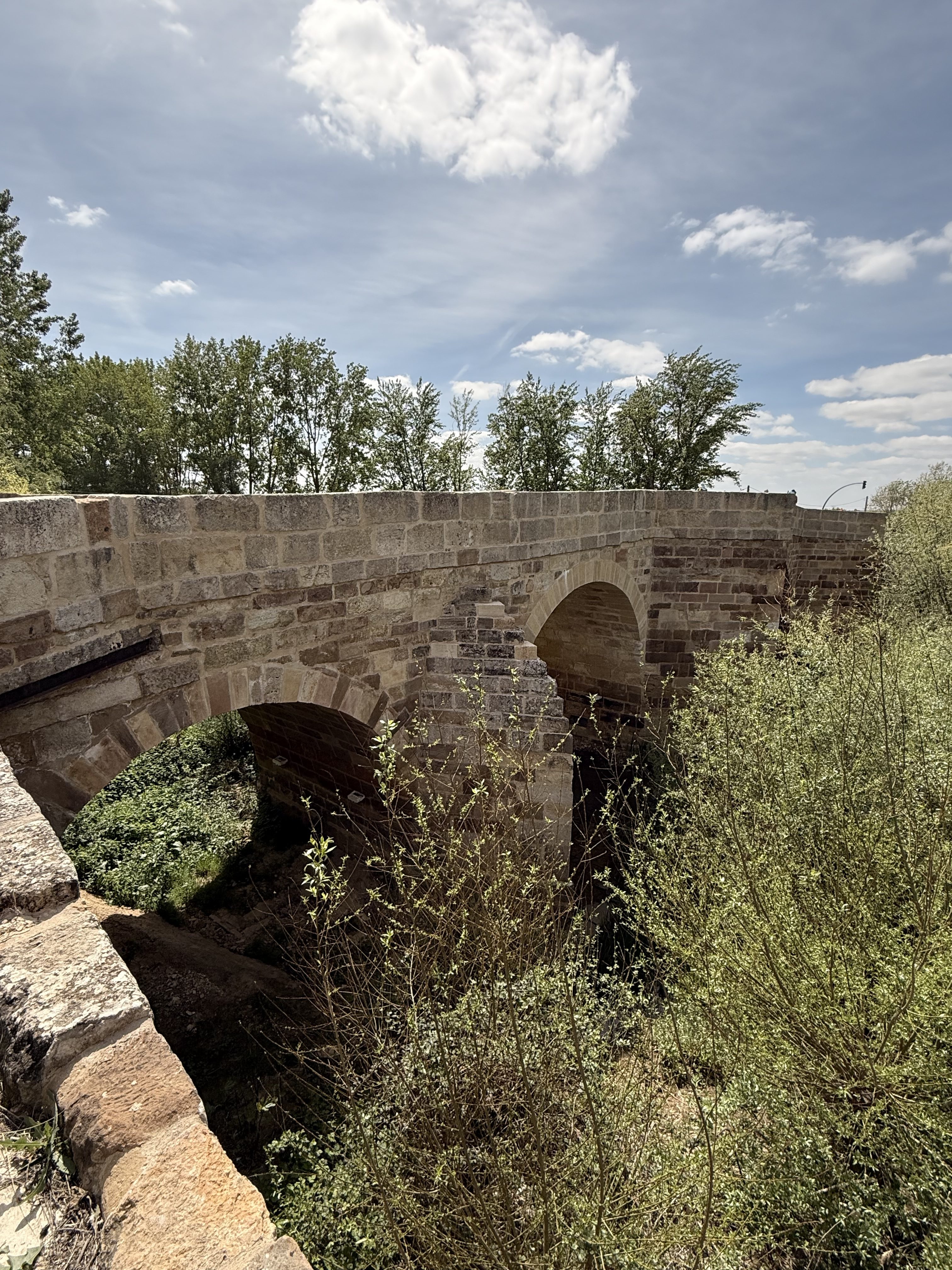
A specific example that Jeff Johnson and I saw this week was the bridge below. At the time, the River Oja area was difficult and marshy. Domingo is traditionally credited with constructing or improving a bridge that allowed pilgrims safer passage.

Roadworks and way-making
Cleared paths, causeways, safer passes, rerouted tracks away from swamps/river hazards. Basic “keep it passable” labor. Often driven by local clergy (organizing labor and donations) and then adopted by towns.

Bridges (the primary safety addition)
River crossings killed people and stalled commerce. The Camino answers with stone bridges at choke points. Bridges also helped consolidate the path.
Puente la Reina (11th c.): the emblematic “Queen’s Bridge,” built to carry pilgrims over the Arga, traditionally credited to Queen Doña Mayor / Muniadona, wife of Sancho III of Navarre.


Hospitals and Other Pilgrim Care
These structures ranged from a single hall with straw to complex institutions: Shelter (a bed or floor space), basic food, and sometimes medical care. Often attached to cathedrals/monasteries or run by canons; funded by endowments, donations, land rents, and occasionally royal patronage.
San Juan de Ortega develops as a 12th-century pilgrim refuge in a difficult stretch (Oca mountains), originally staffed by Augustinian canons in the tradition recorded for the site.


Monasteries & priories (“service hubs”)
Monastic houses offered: lodging overflow, food distribution (especially in hard seasons), a stable literate bureaucracy for wills/donations, protection via reputation and networks.


(More to come on the infrastructure.)


Thanks for leaving a reply