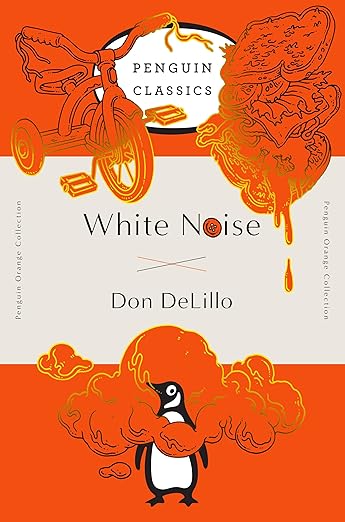
White Noise is a 1985 novel by American author Don DeLillo. A significant entry in the canon of postmodern literature, White Noise tells the story of a small-town college professor whose suburban routine is shattered when a train crash results in a massive chemical spill. As the characters struggle to accept their own mortality, the book explores a range of contemporary issues including consumerism, mass media, and conspiracy theories.
Jack Gladney and his wife Babette who are both afraid of death. Jack is head of Hitler studies at the College-on-the-Hill. His colleague Murray runs a seminar on car crashes. Together they ponder the instances of celebrity death from Elvis to Marilyn to Hitler. Through the brilliant and often very funny dialogue between Jack and Murray, DeLillo exposes our common obsessions with mortality.
I read this during the fires in Los Angeles. It seemed prophetic:
“Because we’re suffering from brain fade. We need an occasional catastrophe to break up the incessant bombardment of information.”
“It’s obvious,” Lasher said. A slight man with a taut face and slicked-back hair.
“The flow is constant,” Alfonse said. “Words, pictures, numbers, facts, graphics, statistics, specks, waves, particles, motes. Only a catastrophe gets our attention. We want them, we need them, we depend on them. As long as they happen somewhere else. This is where California comes in. Mud slides, brush fires, coastal erosion, earthquakes, mass killings, et cetera. We can relax and enjoy these disasters because in our hearts we feel that California deserves whatever it gets. Californians invented the concept of life-style. This alone warrants their doom.”


Thanks for leaving a reply