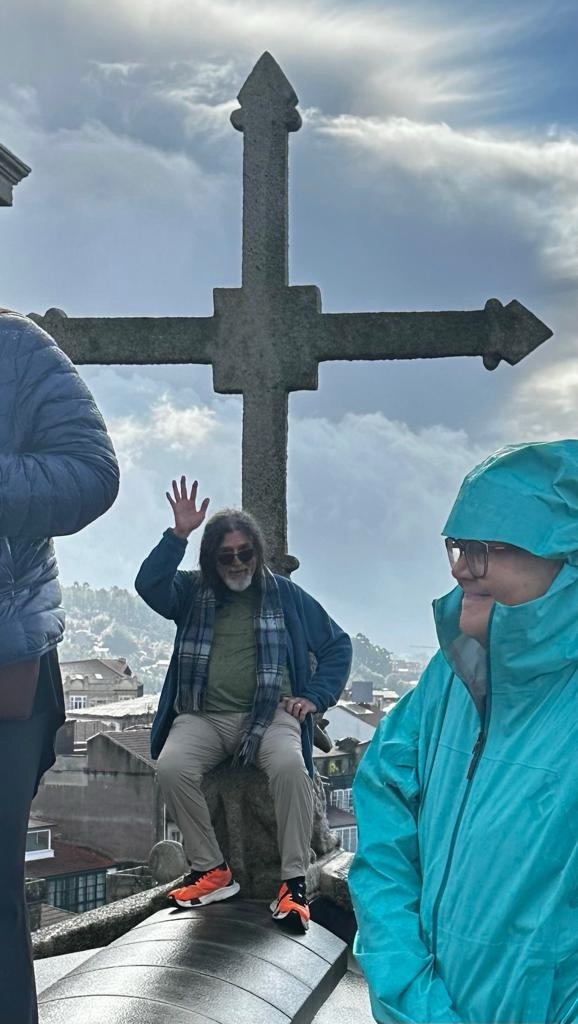
Before setting out step by step, it is worth pausing to ask a quieter question: “Why walk at all?” Why has humanity, across continents and centuries, felt compelled to leave home in search of something that cannot be purchased, scheduled, or fully explained? As a teen in the 1960’s we thought it was important to go to Europe to “find our head!” Not that it did any good.
As a hopefully more mature man in my 70’s I recall when going through a difficult time, someone counseled me to “get up and start putting one foot in front of the other.” I, in turn, have given others this same counsel. One thing I discovered on the Camino in 2023 was that if you have an agenda about what you want to learn, forget it. I was told, and I believe, the Camino will teach you what it wills. Just walk and pay attention.
The Camino illustrates the pilgrimage belongs to a much older, wider human instinct—one that appears in the great religious traditions of the world. Though their doctrines differ, Christianity, Islam, and Hinduism each preserve a shared pattern: the world is not random, the human person is not at rest, and life itself is a movement toward return.
The opening of the Gospel of John declares that “In the beginning was the Word.” Creation is not an accident; it is spoken. In Islam, the Qur’an is received as the very speech of God, and creation itself unfolds at the divine command: “Be, and it is”. In the Hindu tradition, the sacred syllable “Om”, reflected in texts like the Upanishads, is understood as the primordial sound from which all existence flows.
In each case, the world has a source that is not silent. It is spoken, sung, or willed into being. We are not merely present—we are addressed.
And yet, if we are addressed, we are also alienated. The same traditions that affirm a sacred origin also insist that we are not fully at home. Islam reminds the believer, “To God we belong, and to Him we return,” implying both origin and distance. Hindu thought names this condition as ignorance or forgetfulness, a drifting within the cycles of birth and death.
For the Christian, the book of Romans tells us, “We all have sinned and come short of the glory of God,” and at the same time we are told to “work out your salvation”. For Christians it reflects the life long work of sanctification, the need to reach for holiness.However it is described, the human condition is not one of arrival, but of displacement.
The Road of the Living—and the Dead
It is here that pilgrimage emerges—not as an optional religious exercise, but as something closer to a necessity. If we are created, and if we are estranged, then something in us must move. One step at a time begins to do what the soul already knows. Go.
As I walked I began to suspect the journey is not uniquely Christian, but deeply human. Across traditions, this movement takes recognizable form. The Muslim undertakes the Hajj to Mecca, circling the Kaaba in a ritual that echoes both origin and return. The Hindu pilgrim journeys to Varanasi or the Ganges, seeking purification in waters believed to carry the memory of eternity. The Christian sets out for Santiago de Compostela, Rome, or Jerusalem, walking toward places where heaven and earth seem to meet.
Different paths, different theologies—yet the same movement: away, and then back again.
Pilgrimage, then, is not merely about reaching a destination. It is about finding truth. We leave what is familiar. We accept discomfort, and pain. We carry only what is necessary. We become, in a small but real sense, dependent again. In doing so, we rehearse death—the letting go of control, identity, and accumulation. And we rehearse a rebirth—the rediscovery of meaning, dependence, and grace.
This is why pilgrimage persists even in a modern world that prides itself on efficiency and immediacy. The airplane may take us faster, but it cannot do the work of the road. Only the slow accumulation of steps can teach what must be learned slowly: that we are not self-sufficient, that we are not yet home, and that the return requires participation.
The Camino, in this light, is both deeply Christian and profoundly human. It is Christian in its history, its saints, and its destination at the shrine of Saint James. But it is human in its structure. It answers a need that precedes any single tradition: the need to move toward what we have somehow lost, or forgotten, or not yet fully known.
The Old Testament figures of faith, such as Abraham and Sarah, who regarded themselves as temporary residents or travelers on earth, seeking a heavenly home. “All these people were still living by faith when they died. They did not receive the things promised; they only saw them and welcomed them from a distance, admitting that they were foreigners and strangers on earth.” (Hebrews 11:13 (NIV))
To walk the Camino is to step into this ancient pattern. It is to accept that life itself is a kind of pilgrimage—one that begins in gift, passes through estrangement, and seeks, however imperfectly, a return.
Abraham leaves without knowing where he is going, but he does not walk alone. Moses leads his people through wilderness, sustained by provision they did not produce. The psalmist speaks of pilgrims whose hearts are set on the way, passing through the Valley of Baca and finding it, somehow, a place of springs.
The Camino simply makes visible what is already true.
We are, all of us, moving.
We are, all of us, dependent.
We are, all of us, passing through structures—some built by others, some given by God—that make the journey possible.
The Camino is not an escape from life. It is a clearer version of it. And every bridge, every stone, every place of rest along the way is quietly asking the same question:
Will you walk it as a traveler—or as a pilgrim?
There is a kind of faithfulness in walking, even when the end is uncertain. Even when the body cannot sustain what the will desires.
Finishing the Camino was never the only measure. The Camino, in its older understanding, did not promise survival. It promised meaning.
[Part Four: Proposed Daily Schedule}


Thanks for leaving a reply