(Part One) Stephen Griffith
Stepping Out of the Boat
I was working at my desk on a new project in the summer of 2023, having just come to the end of a three-year musical endeavor that, toward the end, had begun to bore me. I cannot even remember what I started next, only that one day I abruptly stopped. Why had I pushed myself so hard? I had no real need. Perhaps it was an escape. Perhaps I needed to convince myself I was doing something worthwhile. By then I was already in a downward spiral—caught up in politics and the way they had strained my relationship with, and ultimately led to my exile from, the church. I was lost. I needed something to jolt me back to life.
Matthew 14 describes Christ’s disciples (former strapping fishermen) sailing across the lake when they saw, in the midst of the storm, Jesus walking across the water towards them. As the narrative progresses, Peter called out, “Lord, if it is you, command me to come to you on the water.” He said, “Come.” So Peter got out of the boat and walked on the water and came to Jesus. But when he saw the wind, he was afraid, and beginning to sink. (ESV) Peter was not condemned for this but it helped to transform him from an impetuous, often flawed disciple into the foundational “rock” of the early Church. It all started by stepping out of the boat. Which is what I needed to do.
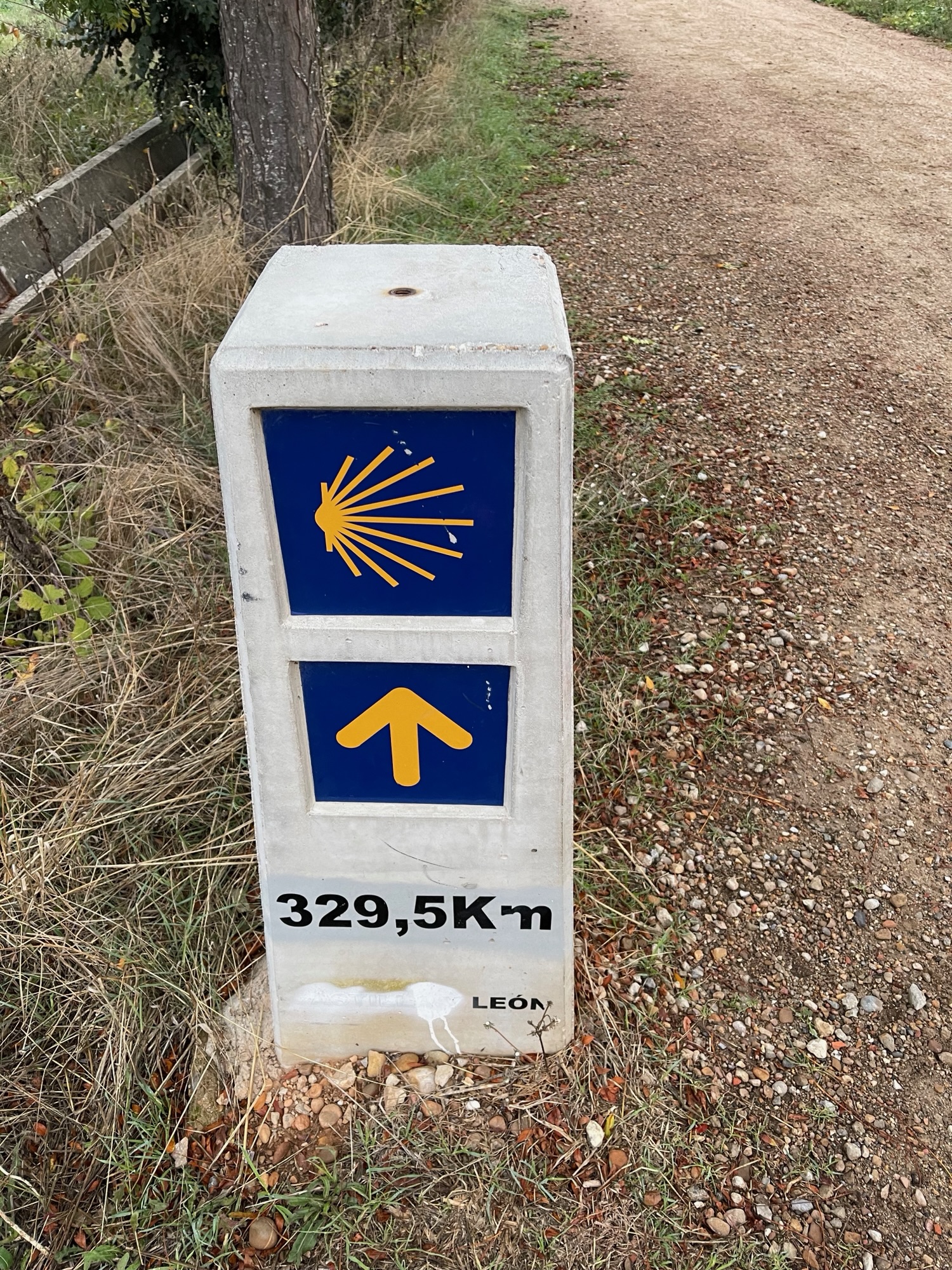
Prior to 2023, the only “Camino” I had heard of was the Chevrolet model discontinued in 1987. But somehow the Camino Francés came to my attention. The 500 mile walk from France to the coast of Spain felt like something to shock me out of my lethargy. Perhaps a restart. My family, fortunately, gave me the go-ahead, and I landed on the Camino with no agenda (and little preparation) but the trail itself. Granted, I went for the walk and not much else. This was not how, or why, the Camino began.
Starting in October of 2023, the first weeks became an accumulation of physical strain, mental anguish, loneliness, and a general sense of confusion. And yet, I found myself in awe—of the architecture, the food, the vast and varied landscape. Beauty and discomfort walked hand in hand.
Midway through, I was in agony. I wanted to quit. My worst day on the trail was from O Cebreiro to Triacastela. I had an estimated thirty minute walk left to Triacastela, when all of a sudden I was hit with intense leg pain, cramping, numbness, weakness, and pain in my hip. People stopped to help, but language and isolation made it nearly impossible. I’m not sure how long it took me to get to the bed and breakfast where I was staying. I would walk a few steps and rest. When I did finally arrive I could barely walk with the pain and dizziness. As a result, when I was greeted by the front desk, they gave me the nearest handicap room without me asking. The next day I felt better, but still aching and kept walking.
And somewhere along the way I began collecting friends. Or rather—truth be told—as a lifelong introvert, others began collecting me. In time they became friends. The meals together, and cafe rest stops were great times of conversation, revelation, and humor. Once, improbably, we found ourselves in a Michelin-starred restaurant for a unique experience. (This wasn’t in the spirit of the medieval pilgrim, more 21st century.)
It was, in every sense, a great experience, and some of those friendships remain. I returned home with renewed energy and a different posture toward life. Later, a friend said to me, “Someday I want to hear how the Camino changed your life—if it’s not too personal or too much effort.” I don’t mind personal, and I don’t mind effort, but I have found it difficult to put into words.
I even asked my family whether they noticed any changes in me. They were kind in their answers, but what they observed was mostly on the surface: more energy, a greater openness to friendships. Whatever had happened internally had not yet fully surfaced.
A Beginning, Middle, and End (The Human Condition)
As I began to sift through my memories and feelings, I came across the term tripartite structure—a system composed of three distinct yet related parts. It suggests balance and movement: a beginning, a middle, and an end that belong to one another.
The beginning, middle, and end structure is what every writer faces at the keyboard. But most conflict in life can be a tripartite structure: one’s coming of age story, divorce, coming out as gay, transexual, escaping religious abuse, departing from the religion of your roots, etc. It did not take long to recognize the pattern.
First, there was separation. I left behind not only home but a former version of myself—one already fractured by disillusionment and loss. Pilgrimage begins, as Scripture so often does, with departure: Abraham leaving his country, Moses leaving Egypt, the disciples leaving their nets. To step onto the Camino was, knowingly or not, to step into that same pattern. Something had to be left behind.
Second came what might be called the in-between—a phase marked by ambiguity, vulnerability, testing, and slow transformation. This is the long road itself. Here the pilgrim is stripped of certainty. The body aches. The mind questions. One confronts limits of the body, mind, and soul. And yet, this is also where unexpected grace appears: in the kindness of strangers, in shared meals, in laughter that feels unearned. Counselors often describe this stage as a kind of wilderness—a place not of punishment, but of emergence. On the Camino, I was not simply walking across Spain; I was being unmade and, in some quiet way, transformed.
Third came return. I arrived home carrying something I could not fully articulate—a sense of accomplishment, yes, but also something deeper and less defined. Not resolution, exactly, but realigned. In Christian terms, this stage echoes resurrection—not as a final answer, but as the beginning of a new way of living. One returns to the same life, but not as the same person.
The Camino itself traces its origins to the ninth century, when, according to tradition, the tomb of Saint James was discovered. Over time, it became one of the great Christian pilgrimages, drawing travelers from across Europe. Today, the Camino Francés remains the most well-known route, rich in cultural memory and historical, Catholic, spiritual significance, inviting modern pilgrims to walk paths worn smooth by centuries of faith. But today, the Camino is walked by a wide range of people with varying motives. But, in 2023, of the half million who traveled the Camino, 42% cited spiritual reasons for their walk, 34.7% walked with a combination of religious and secular motivations, and nearly 23% were motivated by personal growth, cultural exploration and a sense of adventure. I saw one form where the pilgrim was traveling for the variety of Spanish cuisine.
Spirituality?
Today, spirituality is “neither an organized religion nor a systematized philosophy but a group of ideas and a network of communication.” And while there are myriad reasons for walking the 500 miles, sometimes in pouring rain, snow, blazing heat, as well as pain, the Camino de Santiago is more than a historical route or a physical challenge. It is, at its core, an invitation to metamorphosis. It offers both exertion and reflection—body and soul engaged together. The Camino is not merely a road, it is a theological drama written into geography and stone.
The word “spiritual” has expanded in modern usage to mean almost anything—and therefore, very little. But for over a thousand years pilgrims have walked toward Santiago with the intuition that the journey mirrors the Christian life itself: illumination, confession, death, communion, resurrection. Medieval Christians understood pilgrimage as preparation for dying well.
A Pilgrimage Toward Eternity
I began thinking about the Camino as a journey defined by arrival. A beginning in Saint Jean Pied de Port in France and ending at Santiago de Compestela, Spain, with a long, demanding middle that, if endured, would deliver you to the Crypt of the ApostleJames.
That is the story we tell. But it is not the only story the Camino holds. There is another one—less visible, rarely told in full that runs alongside the road. It does not end in the cathedral. It ends in the ground.
Death on the Camino was not an exception. It was expected. Not everywhere, and not constantly, but predictably, almost geographically. There were stretches of the road where the strain of the journey revealed what had been hidden.
After León, when the last great city fell behind, exhaustion surfaced. Illnesses that had been carried quietly began to declare themselves. This was my experience when I was hit with manifestation of my Peripheral Artery Disease outside of Triacastela. But in the early centuries there was less infrastructure, fewer resources, and less illusion that one could simply push through.
At the rivers—the Órbigo, the Miño—there were other dangers. Water has a way of humbling intention. A misstep, a fall, an infection that followed.
And then the mountains. The Bierzo. O Cebreiro.
Cold, hunger, exposure, wolves. Bodies that had already been stretched beyond their design finally gave way—sometimes suddenly, sometimes slowly. Pneumonia. Heart failure. The quiet collapse of a system that had been running on will alone.
Pilgrims would press on, knowing they were failing, determined to arrive. And many did—but only just. Some died within sight of the end. Others shortly after.
To walk the Camino was not simply to seek blessing, but to practice surrender, prepare for eternity—to live, for a time, as one already on the way to judgment and mercy.
I completed the physical journey in 2023, but I came to feel that something in me remained unfinished. After my return I became obsessed with knowing the why and how of the Camino pilgrimage. Who made the trek and why? How did the infrastructure of the Camino develop? And what could I learn from this knowledge? That is why I decided to walk the Camino again—this time, more attentive to its deeper purpose.
And perhaps that is what I only began to understand—that the road is not simply something we travel, but something that, in time, becomes revelatory, or even redemptive.
[Part Three: Why Walk?]


Thanks for leaving a reply